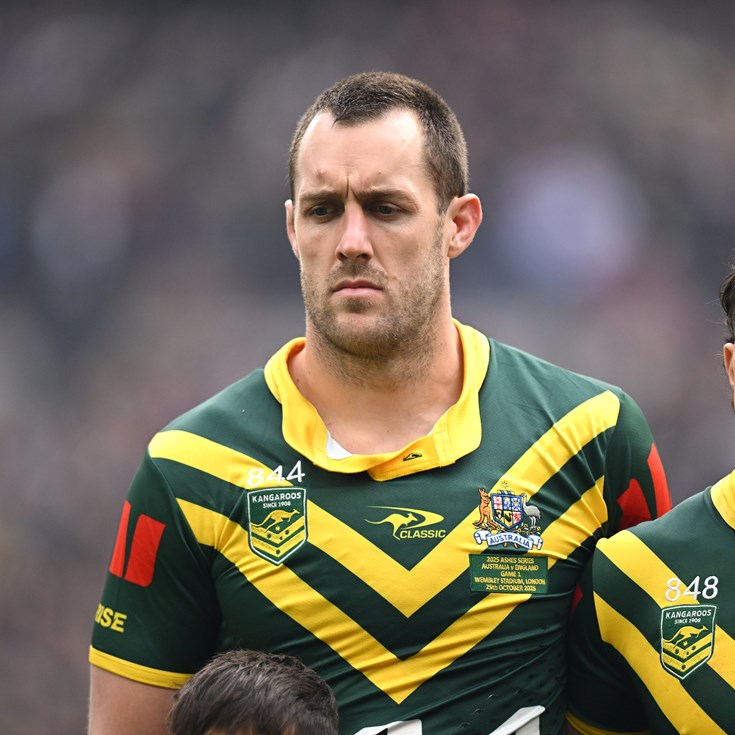
It was a gleaming new stadium but the host city provided a painful reminder for 52,106 fans in Liverpool - the English have still not won the Ashes since the year the Beatles broke up.
The ultra-professionalism of the NRL has this century proven fatal to almost every hoodoo in rugby league but the grandest of them all remains, Australia’s 14-4 win over England at Hill Dickinson Stadium making it 14 successive Ashes series victories since 1973, or 13 successful defences in a row.
And as the players filed out of Everton's freshly minted A$1.6 billion waterfront home on Saturday night, they revealed the lore coach Kevin Walters - a 1990 and 1994 tourist - passed down from his Kangaroos coach Bob Fulton, a member of the 1973 side that clinched the urn.
It's a mantra that has delivered the Kangaroos from calamity for 52 years and helped them shrug off a blood-and-thunder first half on Saturday with their belief untarnished.
Cameron Munster Try
“Kevvy always speaks about it, the senior players always speak about it - we've got the best players in the world, part of this team,” said winger Josh Addo-Carr. "If you're wearing the green and gold jumper you're probably the best player in your position in the world
“All you've got to do is worry about your job. You don't have to worry about anyone else's. That's what makes it so easy.
“When you play with good players, all they have to focus on is their role in the team and it goes a long way to getting a result.”
This DNA-infused belief helped the Kangaroos put England to sleep in the second half at Wembley and so it was again at Liverpool, when it was 4-4 at the break.
Walters proud of gritty Australian victory
"I've been sharing some old stories," Walters admitted. "They're probably not all that great. But that was an old-style Test match and a lot of these guys haven't experienced that."
A penalty against England for holding down in the tackle after 25 seconds seemed to confirm the worst fears of those who felt referee Grant Atkins’ style would disadvantage the home team - but this proved a misnomer as Shaun Wane’s side dominated territory from the outset.
It was fiery, too, Herbie Farnworth throwing the ball at Harry Grant on one occasion while Tino Fa'asuamaleaui and Dom Young were sent to the sin bin after jostling.
But after so much effort expended by the English, the try five-eighth Cameron Munster scored nine minutes into the second half, after he caused the defence to stop when he paused himself, seemed to knock the stuffing out of England and their fans.
There was silence across the previously deafening terraces, a feeling of mass resignation.
And when forward Hudson Young - who described it as the most hostile crowd he'd ever played before - touched down after a bomb bounced fortuitously in front of him two minutes later, it just seemed to confirm what everyone already knew.
Hudson Young Try
In most games down 14-4 with half an hour left is no crushing blow but against an opponent who's held the trophy for 53 years, it appeared to be soul-destroying.
Because when you've got the best players in the world in every position, you know it. And the opposition knows it too.
Man of the match Munster was almost the first player to have a half-time interview cut off because he was talking too much, so detailed was his assessment to the BBC’s Tanya Arnold about what was going wrong.
"We had to be great defensively tonight because we were pretty pathetic with the ball in hand," he said later.
England captain George Williams theorised "we're not as good as we thought we were at the start of the series" while coach Shaun Wane reckoned "the switch-off 10 minutes after half-time hurt us immensely".
Munster on his player of the match performance
He said Super League needed to be more intense and he hoped talks last week between the NRL, RFL, Rugby League Commercial and clubs would help.
"Australia, they play a lot of 'Test' matches in their competition and we play 10, 15?" he said. "The more Test match games we play, the better for all the players in our comp."
Whatever improvements are made to British rugby league in the years ahead, it's fair to say a simple credo passed down from Australian champion to Australian champion over two generations has now had its impact on a third.