Ponga send-off and judiciary process explained
- Author
- Timestamp

NRL GM of Elite Football Graham Annesley has backed referee Ashley Klein's decision to send off Queensland fullback Kalyn Ponga in Origin I.
Annesley also explained why Ponga received a fine - not a suspension - under the judiciary process for representative matches introduced in 2022 with the intention of penalising a player guilty of foul play in Origins or Tests, and not his club.
Ponga was sent from the field in the 57th minute of Wednesday night's Origin series opener at Accor Stadium for a shoulder charge that forced NSW winger Tolu Koula from the field.
Koula failed his HIA and will miss the next two matches for Manly under the NRL's concussion protocols requiring a mandatory 11-day stand-down.
Ponga sent off
Annesley said the incident involved "clear and forceful contact" with Ponga's shoulder to Koula's head and there were no mitigating circumstances.
Klein made the decision to send Ponga off after asking Bunker official Chris Butler to review the incident.
Butler advised it was "at least a sin-bin", and the decision on whether Ponga should spend a minimum 10-minute stint off the field or be banished for the remainder of the match was then up to Klein to determine.
The Maroons were leading 20-6 at the time but went down 22-20 as the Blues capitalised on the one-man advantage to score three unanswered tries in Ponga's absence.
The Newcastle captain was charged by the Match Review Committee with a Grade 2 Shoulder Charge and received a fine equating to 23 per cent of his match fee after entering an early plea.
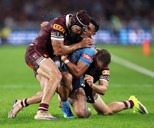
Annesley said: "The NRL supports Ashley Klein's decision to send off Kalyn Ponga during State of Origin Game One.
"This incident involved clear and forceful shoulder-to-head and head-to head contact with no mitigating factors.
"Player safety is extremely important and the game will make no apology for taking strong action on foul play."
Communication between match officials
Unlike general play decisions involving the Bunker, which deals with matters of fact, foul play decisions require the exercise of judgement to determine the appropriate penalty once the offence has been confirmed by the bunker.
This always remains a decision for the match referee under the laws of the game.
"The communication between the on-field referee and the Bunker official allowed for multiple views of the incident live and on replay," Annesley said.
"Confirmation of direct, forceful shoulder to head contact through a shoulder charge action meant the referee decided the correct course of action was to dismiss the player."

Match Review Committee charge
Ponga will play for the Knights on Saturday against the Eels after entering an early plea and accepting a fine equating to 23 per cent of his match payment.
However, if he had pleaded guilty to the same Grade 2 Shoulder Charge offence in an NRL match he would have received a two-match suspension.
Annesley said the judiciary code had been amended four years ago in order to penalise players and not their clubs for incidents of foul play in representative matches.
"Decisions during a match by the Match Officials and the post-match review by the Match Review Committee are two separate processes. The Match Review Committee assigned a Grade Two charge to the offence," Annesley said.
"The Judiciary Code was amended in 2022 to separate Premiership from Representative match penalties. This was to ensure Clubs were not penalised for players' actions during representative matches.
"As a result Kalyn Ponga received a significant fine, rather than a suspension, for the Grade Two offence.
"The Judiciary reforms are designed to directly penalise the player responsible for foul play during State of Origin, rather than their NRL Club."