'Exceptionally succesful': World Cup sets records from opener to finals
- Author
- Timestamp

ARLC Executive Chairman Peter V’landys has praised players and fans for helping to deliver the most successful World Cup yet, with Sunday’s finals being the most watched internationals in history.
More than 4.5 million viewers tuned in to watch the Kangaroos beat the Kiwis, while the Jillaroos victory against the Kiwi Ferns reached a television audience of more than 2 million across the Seven Network.
The men’s final reached a total of 4.52m viewers and had an average audience of 2.49m, while the women’s final reached 2.05m viewers with an average audience of 979,000.
Brisbane’s Suncorp Stadium was also at capacity for the RLWC26 deciders, with a crowd of 52461.
Absolute scenes in Brisbane
The attendance and broadcast figures for the final continued a trend of record crowds and viewership across the tournament, which attracted 425,072 fans through the gate – averaging crowds of 23,615 for each of the 18 match days.
Of those, seven were sell-outs and a number of others were all but sold out.
The five-week tournament also reached audiences totalling 12.2 million across the tournament, with 4.28 million streaming the matches on 7plus.
“I think it's been exceptionally successful. I think the figures show that,” V’landys told reporters in Brisbane as the draw for next season’s Magic Round was announced.
“I think five or six of the most watched programmes on Australian TV will be NRL games and the World Cup, so that shows you how popular it's been. The attendances we've had have been mainly sellouts.
“Look, it's exceeded our expectations. We're expecting to make a profit out of it, which is the first time anyone that's conducted a World Cup is actually going to make a profit.
The 2026 Women's RLWC Champions
“All credit to the players, they just put on a show that you've never seen before, and the fans. The Samoan and Tongan fans, the New Zealand fans, and Australian fans, have been exceptional.
“Some of those scenes you'll never see in sport anywhere in the world.”
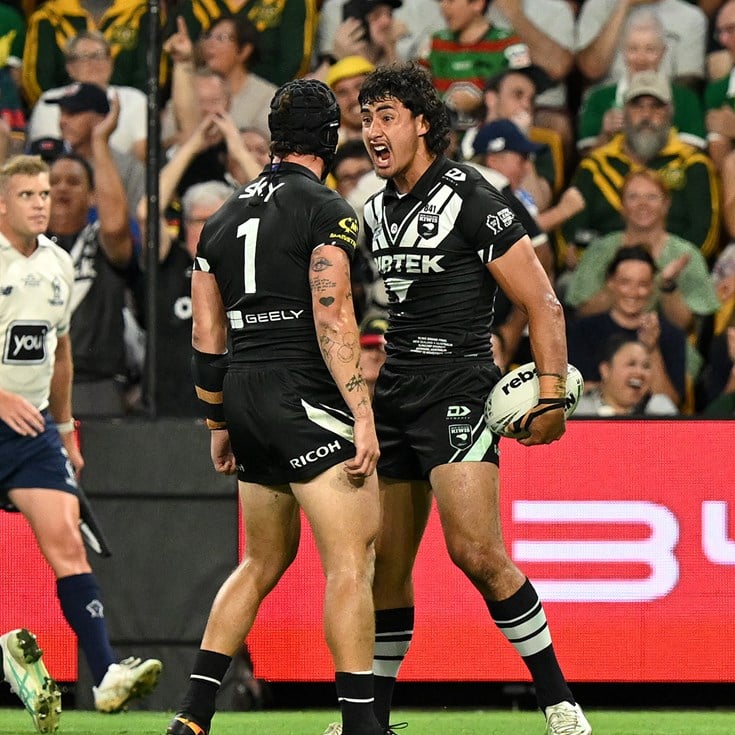
The opening game between Australia and New Zealand at Allianz Stadium started the trend of record attendances and TV ratings, with the 41,225 crowd being the biggest attendance at a Test in Sydney since 1974.

The other sell-out fixtures included the final, the semi-finals at McDonald Jones Stadium and Allianz Stadium, the Round 3 triple header at CommBank Stadium headlined by Samoa v Tonga, the Kiwis v Cook Islands in Christchurch and PNG v Samoa in Port Moresby.
The World Cup opener match on October 15 set a record as the most watched Test - reaching 3.29m and an average audience of 1.73m - but that was surpassed in the semi-final between Australia and Samoa, and again in the final.
Tonga versus Samoa on November 1 attracted the biggest audience for a Test not involving Australia, reaching 2.17m and an average audience of 1.27m.
The men’s final was the most watched international match ever. The match also had an audience of 838,000 on 7plus, the highest streaming audience for an international rugby league game ever.
The women’s final, also set a record as the most watched women’s World Cup and international match ever. The audience on 7plus was 258,000, also claiming the highest streaming audience for a women’s international rugby league game ever.
The ARLC only took over hosting of the World Cup from France in 2024 and is now set to manage RLWC30 in partnership with International Rugby League.
The IRL Board, of which V'landys is a director, earlier this month decided the next World Cup, in 2030, would be staged in the Pacific and United States, including Hawaii, and played under a Magic Round-type format.
V'landys confirmed that some matches could also be played in Australia.

"The International Rugby League has decided to do a Pacific World Cup, and it includes Australia, New Zealand, and the Pacific Nations, in addition to Hawaii and Utah," he said.
"It's going to be a real World Cup because it's going to be spread throughout the world. It's not going to be just in Australia or just in New Zealand, it’s going to go into the United States, including Hawaii."